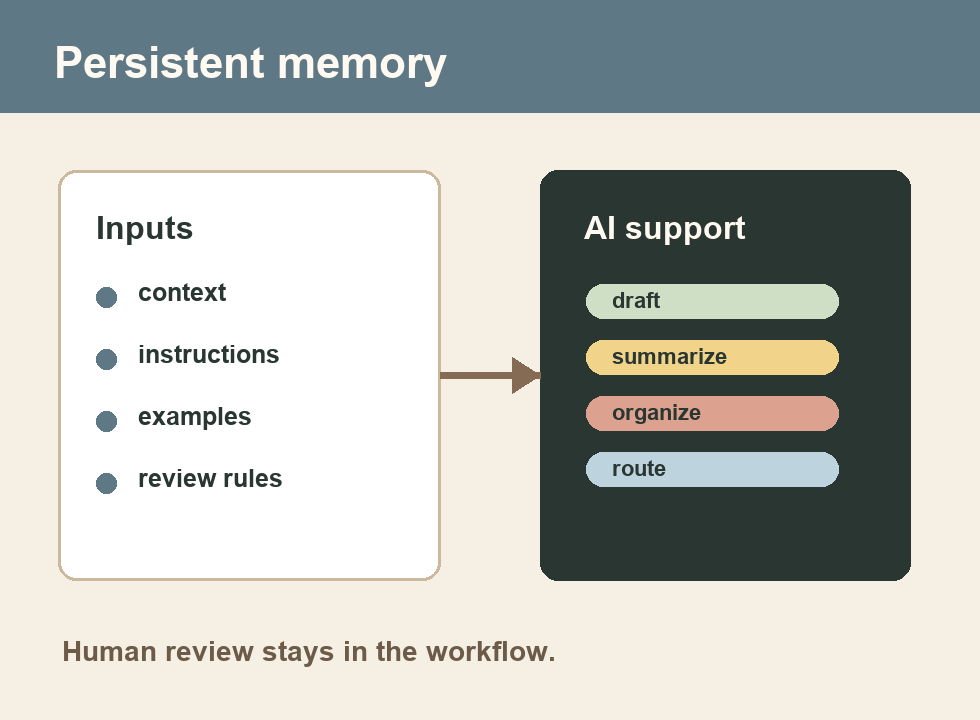
Map
AI Workflow Support
Executive-facing support for teams that need to move from scattered AI experiments to reusable project spaces, clear review rules, and outputs people will use.
Engagements usually begin with one scoped workflow, a clear owner, and a defined output the team wants to improve.
What the work looks like
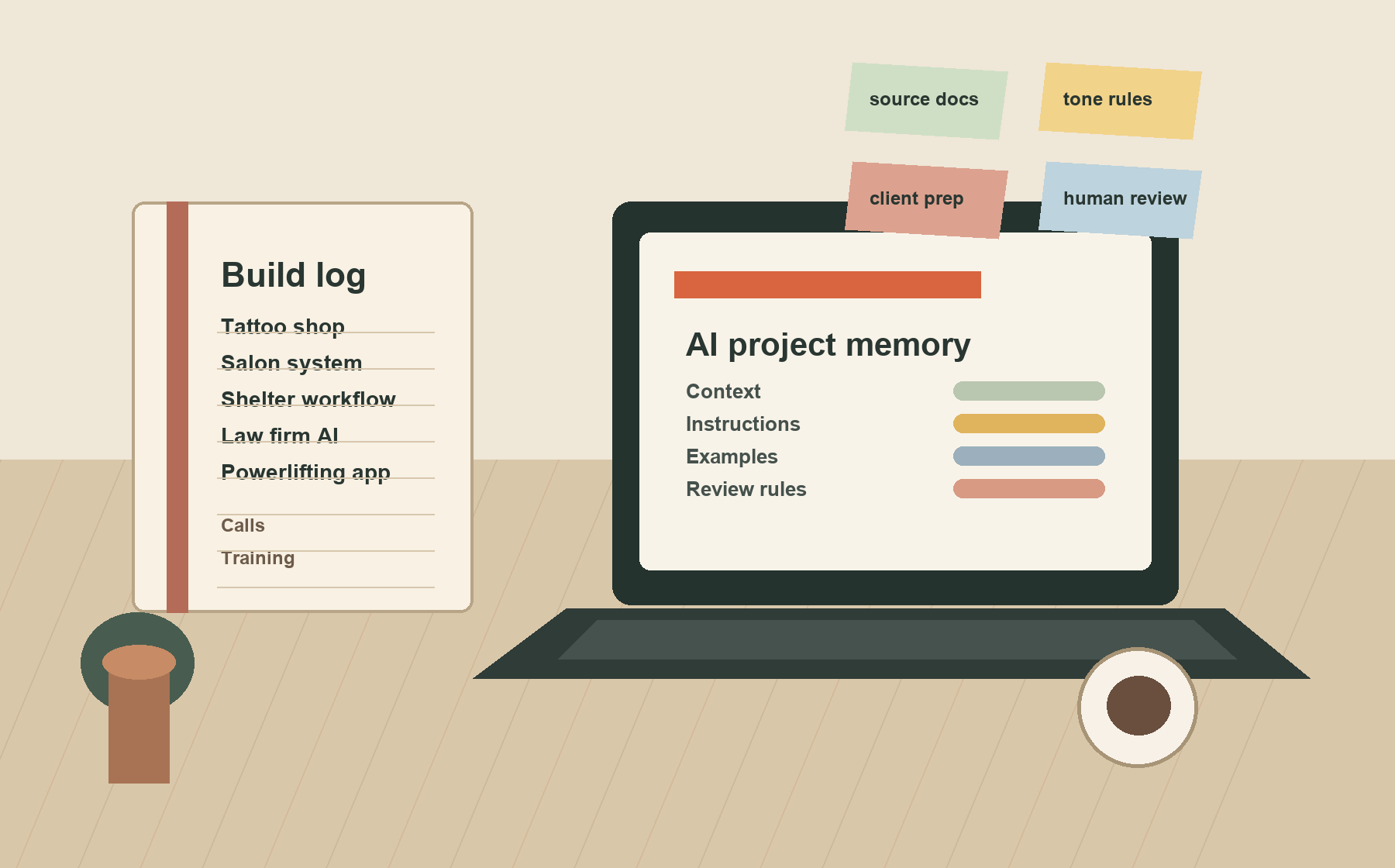
The first useful layer is visible: a workflow map, source context, review rules, and a clear next-workflow queue.
Best fit
Client prep, inbox triage, intake, reporting, follow-up, internal summaries, SOPs, content, or review packets.
The goal is not automation for its own sake. The goal is faster drafting, better context, and clearer human approval.
People have tried AI, but the setup is inconsistent, the outputs drift, or nobody knows what should be standardized.
How it works
The first pass is deliberately narrow. We map the actual work, identify the AI support points, and decide what needs reusable context, what needs a template, and what must stay under human review.
Pick one repeatable process and map trigger, source material, output, owner, risk, and review point.
Create the reusable instructions, examples, tone, source notes, and decision rules the AI needs to do better work.
Turn the workflow into a practical operating habit: what to paste, what to ask, what to verify, and when to stop.
What you get
A clear map of where the work starts, what context it needs, where AI helps, and where a person approves.
Plain-language instructions, examples, and constraints your team can reuse inside ChatGPT, Claude, Gemini, or Copilot.
A short human QA checklist so the team knows what to trust, what to verify, and what cannot be delegated to AI.
A practical backlog of the next processes worth improving, ranked by value, risk, and ease of adoption.
Support model
Example outputs
The goal is not a workshop that evaporates. The goal is a usable operating layer around one real workflow.
Trigger, source material, output, owner, risk, and review point in one shared view.
Plain-language context, examples, constraints, and decision rules for the AI tool your team already uses.
What to trust, what to verify, what needs source support, and what cannot be delegated.
A ranked backlog of follow-on workflows by value, risk, and ease of adoption.
Why Alyssa
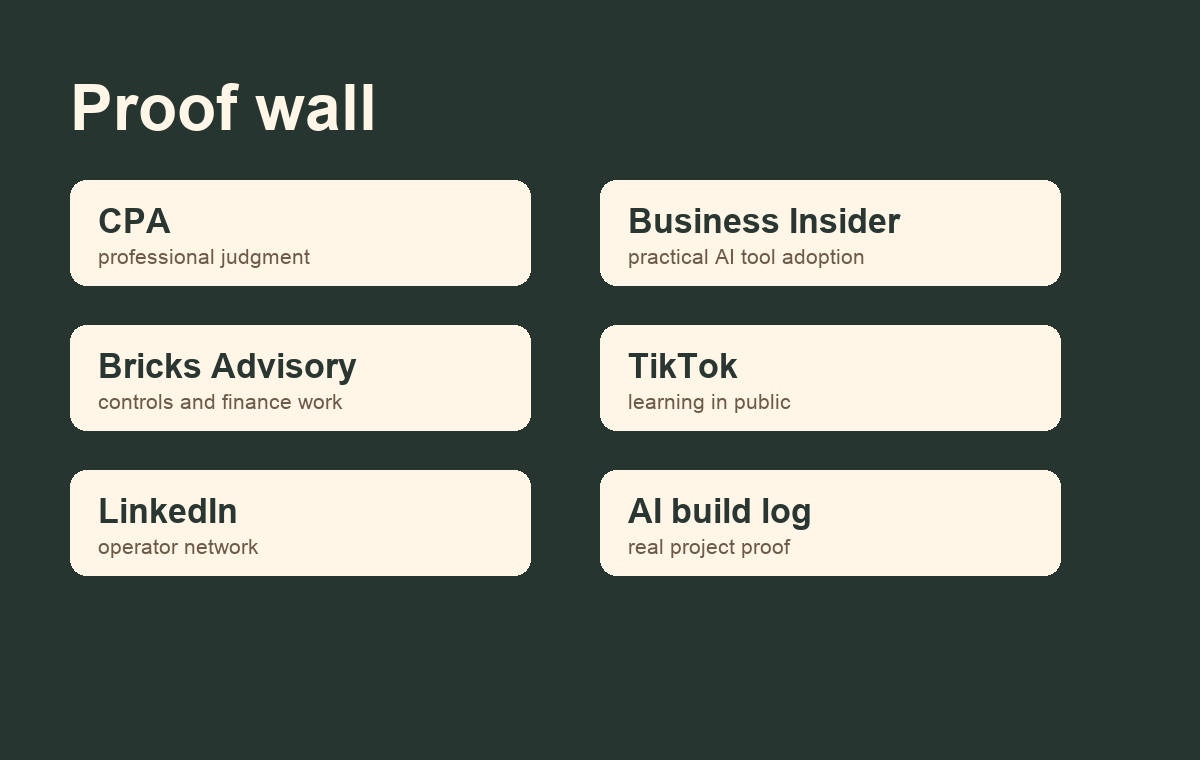
I bring hands-on experience organizing projects, information, and repeatable work into practical AI adoption. That means the work starts with the process, the risk, and the person who owns the final output.
Enterprise trust posture
Client work is treated as confidential. Public teaching and examples are separated from client-specific source material, outputs, and context.
Workflow support starts by deciding which documents, examples, and context are appropriate to use, and what should stay outside the AI workflow.
AI can support drafting, organizing, and review prep, but ownership, verification, approvals, and professional judgment remain explicit.
The workflow comes before the tool. Support can map into ChatGPT, Claude, Gemini, Copilot, or the environment your team already uses.
For sensitive teams, the first conversation can stay at the workflow and risk level until the right confidentiality guardrails are in place.
The goal is not a one-off prompt. It is a workflow map, instructions, review checklist, and next-workflow queue your team can actually reuse.
FAQ
Teams with repeatable work, source material, review needs, and a real owner for the final output.
ChatGPT, Claude, Gemini, Copilot, or the tool your team already uses. The workflow comes before the tool.
One workflow, a few real examples, the current output, and the points where quality, context, or review breaks down.
Not by default. The first layer is usually better drafting, better context, reusable instructions, and clearer review.
Alyssa will point you toward the right lane: diagnostic, build session, team training, or monthly support.
Client-specific material is kept separate from public examples. Sensitive workflows can begin at the process level before source material is shared.
Next step
Send the process you want to improve, the tool your team already uses, and the output you wish were easier to create.
Start with a diagnosticQuestions? alyssa.clarcq@bricksadvisory.com
Open the forwardable overview